The big jar has been chugging right along though, with no mold and just a pleasant tart aroma.
Saturday, September 17, 2011
Pickled peppers update
The two smaller jars developed some really funky smells and some nasty gray mold. I think some clostridium took hold in those, so I tossed them. I've read that if fermenting veggies get mold you can just scrap it off, but the smell was pretty rank so I didn't want to risk it.

Tuesday, September 6, 2011
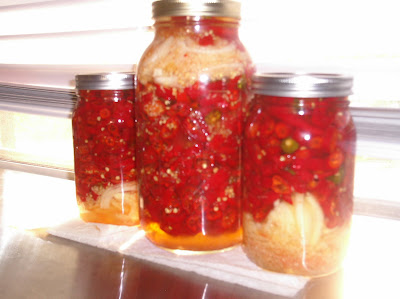
Half-a-peck of pickled peppers
Brewing has opened me up to the world of Lactic fermentation. My neighbor got a good deal on a bushel of cayenne peppers and gave me 3lbs. Here's the recipe I used:
3lbs cayenne peppers
6tbsp of salt
4tbsp sugar
8c H2O
8tsp minced garlic
2 large onions
3tbsp of Kimchi juice
I heated the water, sugar, and salt to thoroughly dissolve, then cooled. I sliced the peppers into rings, and put into jars with the garlice and sliced onion. I then filled the jars up with the liquid part, and added a tablespoon of liquid from kimchi to each jar, to kick off fermentation. This is probably not necessary, but I felt better doing it.
The next day they were bubbling away, and have been for about a week now.
In a few weeks, I plan on blending up the big batch and making hot sauce out of it, and keeping the small batches whole to use in place of pickled jalapenos.
Tuesday, August 23, 2011
Quick and easy cider recipe and tasting
Here's my super easy grocery store cider recipe:
5gal vol.12-14 cans of apple juice concentrate.
1 tbsp yeast nutrient (DAP)
5 bags of Earl Grey tea
Water, probably ~4 gal
S-04 or T-58 yeast
Lactic Acid 88% at bottling (to taste)
Any kind/brand of juice will do, as long as it only has ascorbic acid as a preservative. So just juice, ascorbic acid, water.
Heat 1 gal of water to just off-boiling. Add the tea bags, and steep for 5min. Take out tea bags. The tea bags add tannin to the cider. If you have access to good cider apples (most apples sold are the desert kind, not really great for cider) then this step is unnecessary. Tannins add structure. In large amounts, tannins give red wines their "chewy" character, but in small amounts they lend a subtle body.
Add hot tea water to 2 gal of cold water. Do not add hot water directly to fruit juice. If you do you'll set the pectins and the cider will never clear.
To the now cool 3 gal of tea water, add most of the apple juice concentrate. Check gravity. Adjust volume/gravity until you hit 1.050 and have around 5 gallons of juice.
For a sweeter, appley-er cider, ferment with S-04. For a drier, tart, slightly spicy (think cloves) cider, use T-58. Ferment as close to 60* as possible. Should be ready to bottle within 7-10 days, but verify via hydrometer. T-58 will take longer to clear. S-04 will blow through the sugars within a few days and flocc out quickly.
My T-58 bottomed out at 1.010. My S-04 hit 1.016 and flocc'ed. I transferred to secondary and it's still very slowly bubbling away. I bottled the T-58 part of the batch a few weeks ago, and I'm drinking it now. It tasted a little lifeless at bottling time, and the pH was around 3.4. I added 15ml of lactic acid to drop the pH to 3.0. At that pH, it tasted "brighter."
Tasting notes
Appearance: Clear and golden.
Smell: Lightly apple, some bergamot/citrus aroma.
Taste: Fairly dry, a little bland in the middle, but it has a very nice finish. The bergamot from the Earl Grey really shines through in the finish, and nicely complements the apple flavor.
Mouthfeel: Carbonation ended up a little bit low, but it has a nice texture. The tannins complement the dryness well.
Overall: For how simple and easy it is, it makes an easy-drinking, semi-dry cider. I've made cider previously with better juice and wine yeasts and was underwhelmed. Ale yeasts are much better for cider making. If you have access to higher quality apple juice, the product will turn out much better. I was limited by what was available at my local Wal-mart. I think the combo of T-58 with good juice would make a really nice cider.

Wednesday, August 17, 2011
New glassware
I moved to rural Missouri from Colorado for work. I grew up in Fruita, went to school in Boulder, and lived in Denver most recently. Pretty much everyone is perplexed as to why I would move here, even native Missourians. I would've guessed the natives liked living here, but they all seem to think Colorado is nicer. In a lot of ways it is, but there are some cool things about living out in the boonies. One of them is the awesome antique stores and flea markets. You can find some really good stuff here for pretty cheap. My latest haul was $5.
Here are my latest beer-related finds:

A Löwenbräu weizen/pils-ish looking glass and an Old Milwaukee chalice. I was pretty happy to find the chalice. I used to have a Belgian goblet, but I lost it somehow.

I also found an old medicine jug. Not sure on the volume, but it looks like it's about 3L. I've been looking for a good 3L-ish jug for starters. I've been using 3L plastic jugs so far without issue, but I'm worried about long-term contamination issues.
I found some 10gal ceramic crocks like my grandparents used to use to make beer in, but they were in great shape and were $110, so I didn't pick those up.
First Berliner Weisse, pt. 3 - boil and pitch
Gravity when pitching yeast: 1.016
PH when pitching yeast: 2.3
After 24 hours, the wort + sour starter was going nuts. A white pellicle covered the entire top, and lots of CO2 was coming off. The pellicle was there in the morning, but when I went back in the afternoon to take a picture, it was mostly gone, but you can still see a bit on the edges:

After reading a bit more about different Lacto strains, it seems most of them are heterofermentative, even the strains from the yeast labs. My pre-boil gravity was 1.028, and when I checked the wort, it had dropped to 1.016 and the pH was down to 2.3. Lactic acid has pretty much the same gravity as sugar. The gravity drop was most likely due to the lactic acid producing alcohol. It tasted fine, a bit sour, but still pretty sweet. I think once it's done fermenting it'll be pretty puckering.
Here's the bit that I did differently from most Berliner Weisse recipes. Most Berliner Weisses aren't boiled, or are only partially boiled. Since my pH was plenty low, and since I had no idea what other nasty bugs I may have cultured from the grain, I chose to boil a little under half of the wort, and pasteurize the rest.
The half I boiled got the hops, then after a 30min boil, I added the rest of the wort and held between 145-150*F (That's 63-65 for the Centigrade folks) for 30min. The process is called vat pasteurization, and should provide a 3-log kill (99.9%). You can pastuerize faster at higher temperatures, but since my bugs made alcohol too, I didn't want to boil off all the alcohol of an already low-gravity beer.
After I chilled it, I pitched about half of a yeast cake from a batch of Koelsch. This is definitely overpitching in normal circumstances. With the low pH, I was worried about poor yeast performance.
I was quickly running out of daylight last night, so I didn't get a lot of pictures, but here's one of my setup. Bayou Classic KAB-4 burner, 60qt pot, little March pump, and a homemade immersion chiller.

Sunday, August 14, 2011
First Berliner Weisse, pt. 2 - Mash and souring
Got the wort into the carboy to start souring tonight. Here's a picture of the setup for the sour starters:

After about 24 hours, the starters smelled strongly of lactic acid (think sauerkraut). They may have had a slight acetic (vinegar) smell, but were otherwise very clean. I was worried about mold/funk/terrible aromas and flavors, but none of that happened. PH for the solutions were 2.9, +/-0.1, indicating Lactobacillus activity. While they tasted sour, they also tasted sweet, so the Lacto didn't eat all the sugars from the starter.
The bug I'm interested in is called L. delbrueckii, which I believe is homofermentative and thermophilic, meaning it likes hot temperatures and just makes lactic acid, not acid and alcohol like some Lactobacillus strains do. By keeping the temp as high as possible, but below 120*, the L. delbrueckii should grow preferentially over other bugs that may have been on the grain.
It turns out I didn't really need any of that headspace, so next time I'll fill them up higher to minimize O2 and the risk of acetobacter.
Here's the recipe I made for this beer:
Batch Size (L): 18.00
Total Grain (Kg): 2.62
Estimated OG: 1.034
Estimated SRM: 2.4
Estimated IBU: 5.4
Brewhouse Efficiency: 75 %
Wort Boil Time: 30 Minutes
Grain
------
68.7% - 1.8kg Rahr Pils Malt
31.3% - 820g of Colorado Malting Company Red Wheat Malt
Hops
------
25g - Willamette (Pellet, 2.0% AA) for 5.4 IBU
Yeast
------
Reused Wyeast 2565 Koelsch
Water Profile
--------------
Profile: RO
Mash Schedule
-------------
Saccharification Rest - 8L infusion, 30 min @ 151* F
No mash out
Total Grain (Kg): 2.62
Estimated OG: 1.034
Estimated SRM: 2.4
Estimated IBU: 5.4
Brewhouse Efficiency: 75 %
Wort Boil Time: 30 Minutes
Grain
------
68.7% - 1.8kg Rahr Pils Malt
31.3% - 820g of Colorado Malting Company Red Wheat Malt
Hops
------
25g - Willamette (Pellet, 2.0% AA) for 5.4 IBU
Yeast
------
Reused Wyeast 2565 Koelsch
Water Profile
--------------
Profile: RO
Mash Schedule
-------------
Saccharification Rest - 8L infusion, 30 min @ 151* F
No mash out
Sparged with cold water ~ 70* F
Notes
------
Collected more volume than anticipated.
Notes
------
Collected more volume than anticipated.
Berliner Weisse isn't a very big beer. The grain bill looks tiny in my 10gal MLT. I chose to mashout with cold water because I was pressed for time and needed to finish up in a hurry.
 I ended up collecting more wort than I anticipated. I'll check the preboil gravity and volume after it's done souring to adjust boil time and hop schedule as necessary.

Saturday, August 13, 2011
First Berliner Weisse, pt. 1 - Sour starter
The next brew in the works is a Berliner Weisse. This will be my first sour beer so I wanted to start off with something easy. The first step is to make a starter for the Lactobacillus delbrueckii. Pure strains are available from Wyeast and White Labs, but malted base grains are lousy with Lacto (among other things). Since my LHBS is an hour away and doesn't have any bacteria anyway, and it would cost too much to buy a culture online and ship it, I chose the grain route.
Here's the recipe I used:
Into 4L water
Add 400g dextrose
Heat to 110* to dissolve sugar
Divide into 3 growlers
Into each growler goes 1 cup of base malt
One growler got wheat malt, one got pils malt, and one got pale malt. PH of the sugar/water solution was 7.1. I placed the growlers in the shed and wrapped them with a brewbelt heater. Target temperature is 110-120* to maximize Lacto growth.
I wanted to do three separate starters to increase the chance of success. When I harvested wild yeast in the past, half of them took off with good bugs/yeast, and half of them got really rank and nasty. So this way, hopefully at least one will come out alright.
The camera ran out of batteries today, but the next update should have some pics.
Subscribe to:
Posts (Atom)